故事
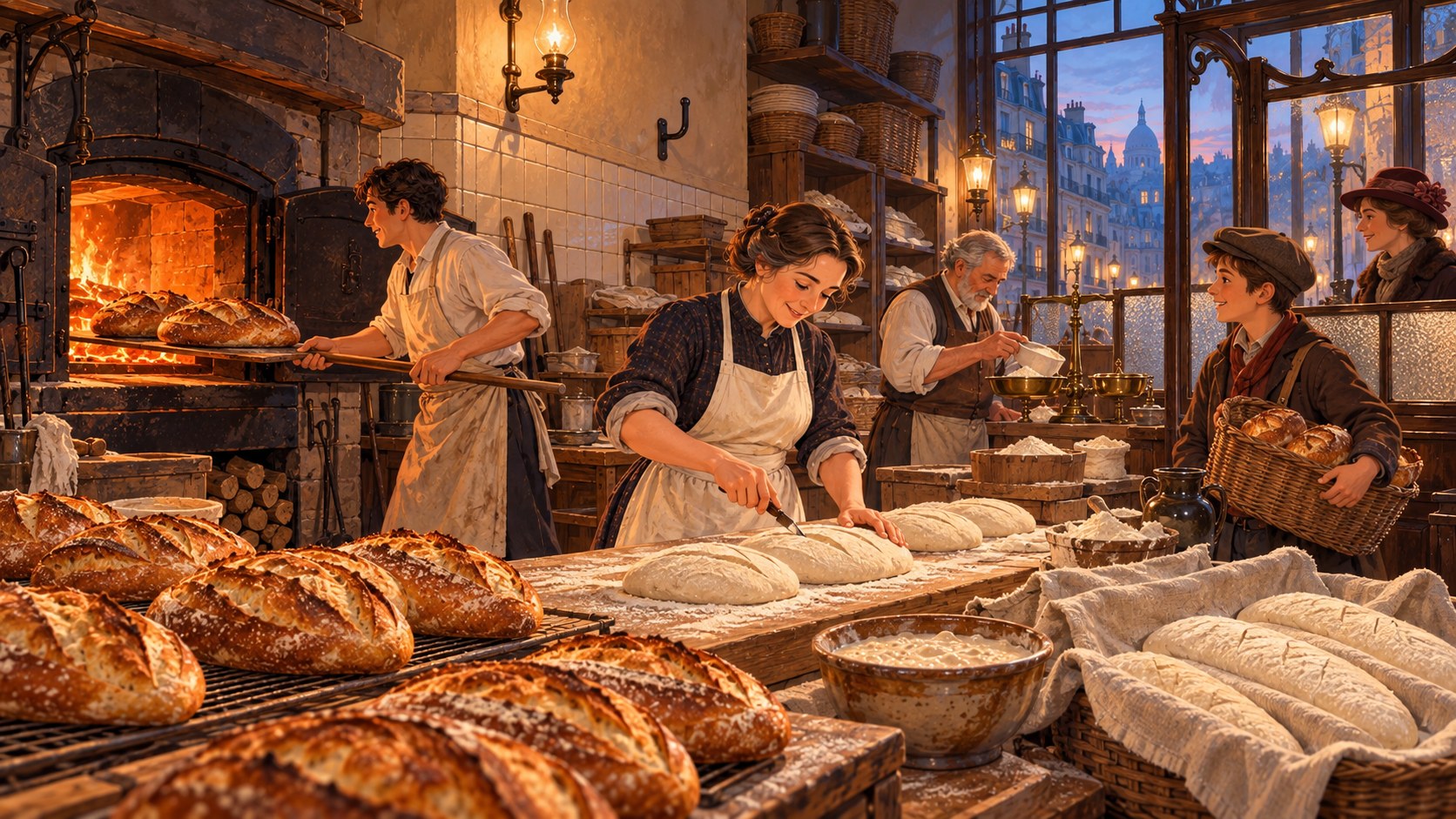
画面正中,穿格子上衣的面包师,左手按着一块长椭圆的面团,右手握小刀,低头笑着划口。案板上撒了面粉,三块面团排成一排,每块都有几道浅浅的口子。
她身后,卷发的小伙子站在炉口,双手握长木铲,铲上两个划过口的面包,就悬在火光上方。灰胡子的老先生,把一勺面粉倒进黄铜天平。戴鸭舌帽、围红围巾的男孩,抱着一篮面包,笑着看她。窗外,戴酒红色帽子的女士往里看,蓝色的街上亮着路灯,远处有一个浅色的圆顶。
左边铁架上,面包凉着。右边藤筐里,长长的面团盖着亚麻布在醒发,旁边的釉面大碗,盛着浅色的稠糊。
这间屋子里,没有一根是法棍。
吉姆·谢瓦利耶(Jim Chevallier)翻遍法语资料,发现十九世纪的面包里没有这个词。1920年8月4日的《费加罗报》写到工人吃“baguette”,词还带着引号,像个新词。同月,塞纳省的一份条例第一次把它当作面包写下来,限价每根最高0.35法郎。
长面包倒是早就有。1850年代到1880年代,美国游客一再写到巴黎的面包有五、六甚至八英尺长。那时这家店卖的,是大圆面包、中间一道深缝的“裂口面包”(fendu),还有细长的“笛子面包”(flûte)。
蒸汽烤炉也有年份。1839年(一说1838年),奥地利人奥古斯特·赞(August Zang)在巴黎开了维也纳面包店,带来蒸汽烤炉,面包皮因此又亮又脆。有书说法棍是他发明的,他那个年代的资料里找不到依据。拿破仑的士兵把面包塞进裤腿,同样没有依据。
1919年3月28日的法律,禁止雇人在晚上十点到早上四点做面包。流行的说法是,这条法律逼着面包师改做又快又细的长条。谢瓦利耶觉得可能,但没有证据,当时的报纸几乎没提。
谢瓦利耶本人也怀疑这条法律起了多大作用。细长的面包在巴黎已经流行了一百多年;baguette 原意是“小棍”,最早的法棍确实很细,更大的长面包叫作 jocko。细法棍和这个名字为什么在1920年前后出现,至今没有定论。有一种说法是面包师的工钱里包括一根小面包,但还没有可靠的资料。
还有一个说法可以放下:说法棍是为了1900年前后挖地铁的工人发明的,免得他们带刀打架。当时的资料里找不到依据。
那时的人面包吃得多:历史学家卡普兰(Steven Kaplan)记录,二十世纪初法国人平均每天约600克,1986年只剩约170克。
窗边的女士还在看。男孩把篮子往上提了提,面包师又划下一刀。
资料来源与延伸阅读
- Jim Chevallier, "About the Baguette: an inquiry into the origin of the baguette" Supports: the word absent from nineteenth-century bread; Le Figaro, 4 August 1920, with "baguettes" in quotation marks; the 28 March 1919 law and Chevallier's view that its role is plausible but unproven; American travellers' accounts of five-to-eight-foot loaves (1850s to 1880s); Zang and the 1839 Viennese bakery with steam ovens; the Napoleon story dismissed.
- Steven Laurence Kaplan, Good Bread Is Back: A Contemporary History of French Bread, the Way It Is Made, and the People Who Make It (Duke University Press, 2006) Supports: bread consumption of about 600 g a day in the early 1900s and about 170 g in 1986 (as summarised in the Wikipedia article below); the baguette's name and shape as a twentieth-century development.
- Wikipedia, "Baguette" Supports: the August 1920 Seine regulation, the first record of "baguette" as a bread, with the 0.35 franc ceiling; the March 1919 night-work law quoted; Napoleon and night-work accounts classed as origin stories; the 600 and 170 gram figures.
- Wikipedia (French), "Baguette (pain)" Supports: long fancy breads (pains de fantaisie) in the nineteenth century before the word baguette; the August 1920 Seine definition and price. The métro myth was raised by a reader on r/AskFoodHistorians (5 Oct 2026) and is listed as a myth in the Wikipedia "Baguette" article. Jim Chevallier (u/chezjim) replied in the same thread on 5 Oct 2026: long narrow loaves dominant for over a century, "baguette" first meaning a wand, the first baguettes very thin, the larger long loaves called jockos, the night-work law of little weight, and the small-loaf-as-pay suggestion unsourced.
- Wikipedia, "August Zang" Supports: Zang's Boulangerie Viennoise opening in 1838 or 1839, the Viennese steam oven, and that his claimed invention of the baguette has no support from any period source.
- UNESCO, "Artisanal know-how and culture of baguette bread" Supports: 2022 inscription; four ingredients (flour, water, salt, leaven and/or yeast); hand shaping, scoring as the baker's signature; baking throughout the day in small batches.