Food story · France
Nobody in a Paris bakery around 1900 sold a baguette. The word is first recorded in 1920.
A story from the painted room “The Paris bakery before dawn”
The story
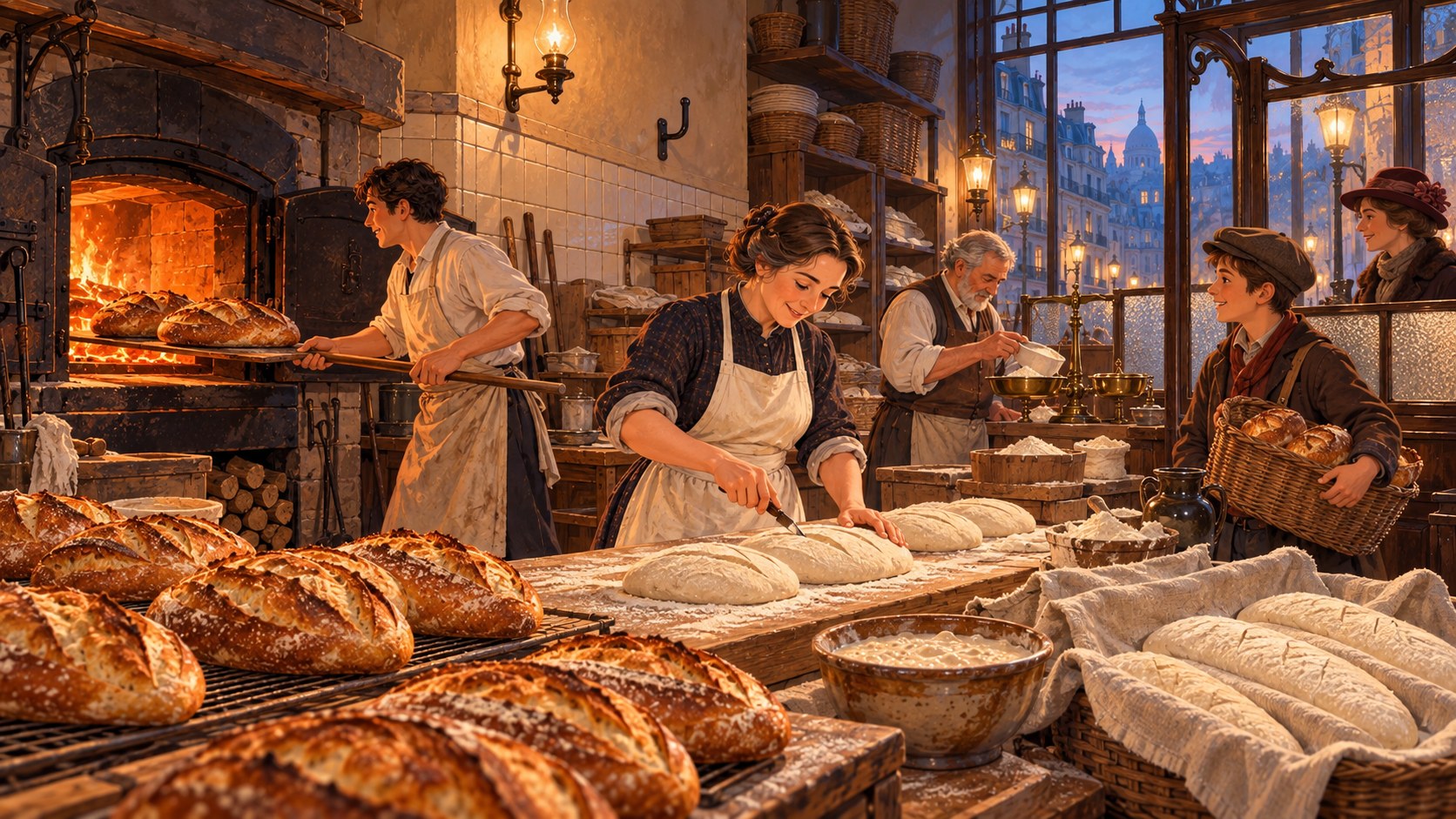
The baker in the checked blouse has her left hand flat on a long oval of dough and a small blade in her right. She is smiling down at it. Three pieces lie on the floured bench, each marked with shallow cuts, and she is cutting the one under her hand.
Behind her, a young man with curly hair leans back from the oven mouth, a long wooden peel in both hands, two scored loaves riding on it above the fire. Split logs are stacked beside the oven. An old man with a grey beard tips flour from a scoop onto brass scales. A boy in a flat cap and red scarf holds a basket of loaves and grins at the baker. At the tall window, a woman in a burgundy hat looks in, and the street lamps glow along a blue street under a pale dome. On the left, cooling loaves sit dusted with flour on a wire rack. On the right, long dough rests under linen in a wicker basket, and a glazed bowl holds something pale and loose.
The loaves in this room are not baguettes, and a baker here around 1900 would not have used the word. Jim Chevallier searched French sources for the origin of the baguette and found the word missing from nineteenth-century bread. The Figaro of 4 August 1920 mentions workers treating themselves to "baguettes" in quotation marks, as if the word were new. A regulation of the Seine department that month is the first record of it as a bread, and it fixed a price ceiling of 35 centimes.
Long loaves did exist. American visitors in the 1850s to 1880s kept remarking on Paris loaves five, six and even eight feet long. A baker here would have sold big round loaves, the fendu with its deep split down the middle, and the long thin flûte.
The steam in the baguette oven has a date. In 1839, or 1838, an Austrian, August Zang, opened the Boulangerie Viennoise in Paris and brought the Viennese steam oven, which gives a crust its gloss and crackle. Some books say Zang invented the baguette. No source from his time supports that. The story that Napoleon's soldiers carried the loaf down their trousers has no support either, and Chevallier points out it would have hindered a soldier on the march.
A law of 28 March 1919 forbade employing workers at bread and pastry making between ten at night and four in the morning. One popular account says this pushed Paris bakers to the quick, slim loaf. Chevallier finds it plausible but unproven: the press of the time hardly mentioned the law.
Chevallier himself doubts the law mattered much. Long narrow loaves had dominated Paris for over a century; the word means a wand, and the first baguettes were very thin, while the bigger long loaves were called jockos. Why the thin loaf and its name appeared around 1920 is still open. One suggestion is that bakers received a small loaf as part of their pay, but no solid source supports it yet.
One more story to set aside: that the baguette was invented so métro diggers around 1900 could tear bread without carrying knives. No document from the time supports it.
Bread was heavier in the diet then. The French averaged about 600 grams a day in the early 1900s and about 170 grams by 1986, Kaplan records. In 2022 UNESCO listed the artisanal know-how and culture of the baguette: four ingredients, flour, water, salt and leaven or yeast, shaped by hand, scored by the baker and baked through the day in small batches.
The woman at the window has stopped to watch. The boy lifts his basket, and the baker makes one more cut.
Sources and further reading
- Jim Chevallier, "About the Baguette: an inquiry into the origin of the baguette" Supports: the word absent from nineteenth-century bread; Le Figaro, 4 August 1920, with "baguettes" in quotation marks; the 28 March 1919 law and Chevallier's view that its role is plausible but unproven; American travellers' accounts of five-to-eight-foot loaves (1850s to 1880s); Zang and the 1839 Viennese bakery with steam ovens; the Napoleon story dismissed.
- Steven Laurence Kaplan, Good Bread Is Back: A Contemporary History of French Bread, the Way It Is Made, and the People Who Make It (Duke University Press, 2006) Supports: bread consumption of about 600 g a day in the early 1900s and about 170 g in 1986 (as summarised in the Wikipedia article below); the baguette's name and shape as a twentieth-century development.
- Wikipedia, "Baguette" Supports: the August 1920 Seine regulation, the first record of "baguette" as a bread, with the 0.35 franc ceiling; the March 1919 night-work law quoted; Napoleon and night-work accounts classed as origin stories; the 600 and 170 gram figures.
- Wikipedia (French), "Baguette (pain)" Supports: long fancy breads (pains de fantaisie) in the nineteenth century before the word baguette; the August 1920 Seine definition and price. The métro myth was raised by a reader on r/AskFoodHistorians (5 Oct 2026) and is listed as a myth in the Wikipedia "Baguette" article. Jim Chevallier (u/chezjim) replied in the same thread on 5 Oct 2026: long narrow loaves dominant for over a century, "baguette" first meaning a wand, the first baguettes very thin, the larger long loaves called jockos, the night-work law of little weight, and the small-loaf-as-pay suggestion unsourced.
- Wikipedia, "August Zang" Supports: Zang's Boulangerie Viennoise opening in 1838 or 1839, the Viennese steam oven, and that his claimed invention of the baguette has no support from any period source.
- UNESCO, "Artisanal know-how and culture of baguette bread" Supports: 2022 inscription; four ingredients (flour, water, salt, leaven and/or yeast); hand shaping, scoring as the baker's signature; baking throughout the day in small batches.