Food story · China
Sichuan's numbing pepper is in a poem more than 2,500 years old. The chilli in the same pot arrived about 430 years ago.
A story from the painted room “Hotpot house”
The story
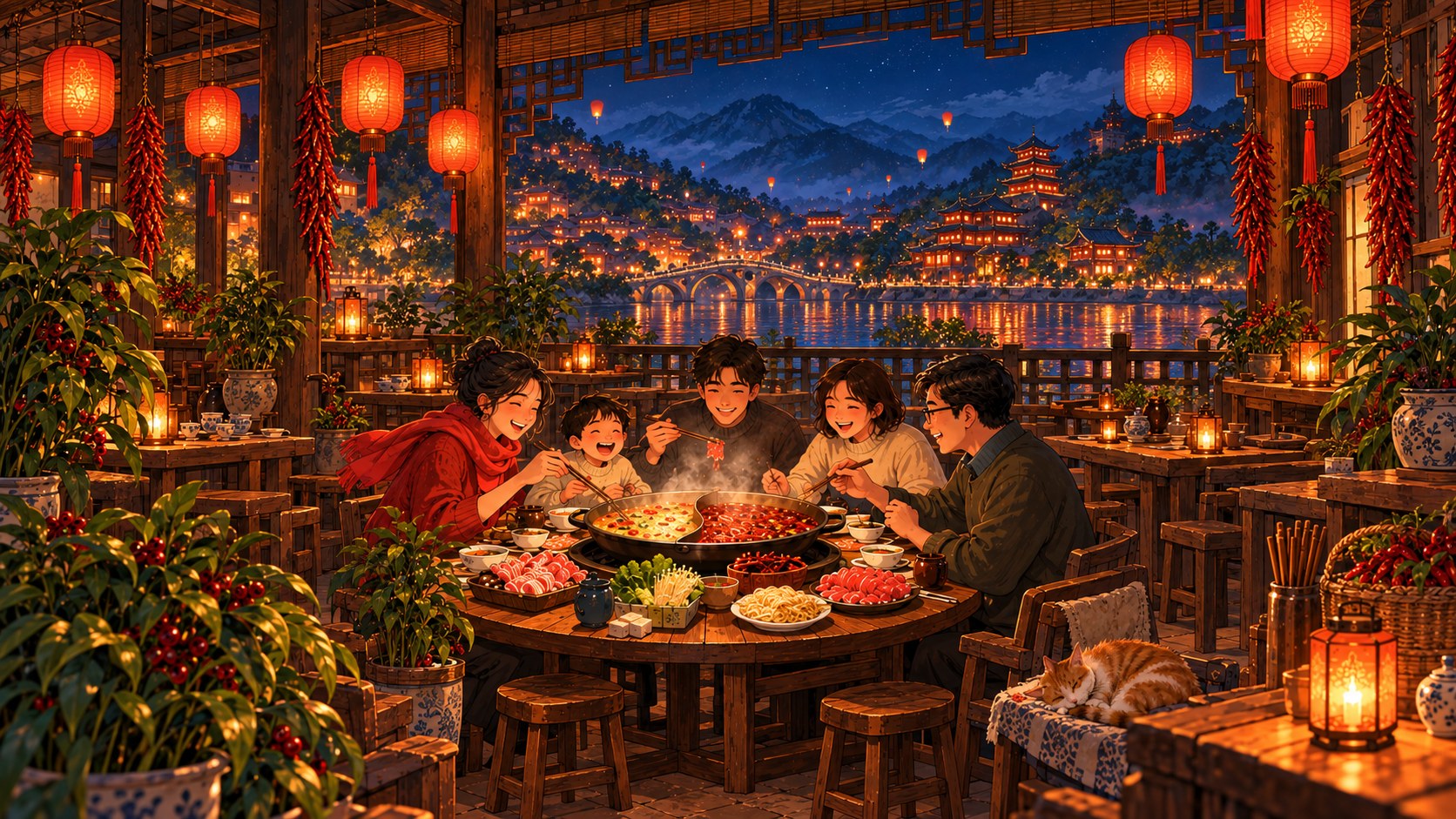
The girl in the cream sweater has her chopsticks in the red half of the pot. She lowers a strip of ox tripe into the boil, lifts it, lowers it again. Seven or eight seconds is the rule at a Chongqing table, and she is laughing too hard to count. Across the pot, the woman in the red scarf is fishing in the clear half for the little boy beside her, who laughs with his whole face.
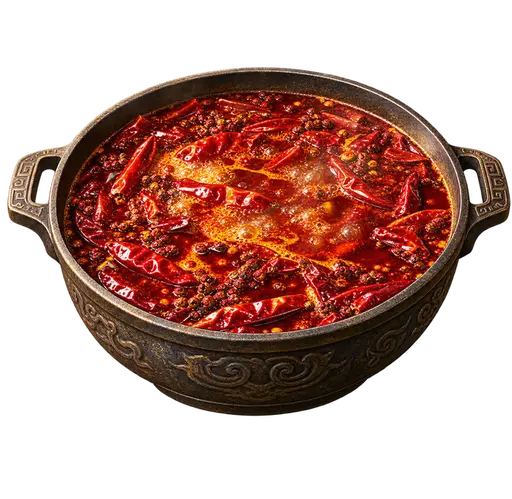
The pot is split down the middle in a curve. On the red side, beef tallow has melted around dried chillies and the small brown husks of Sichuan pepper, and the oil shivers each time the broth rolls. Plates crowd the edge of the table: marbled beef, enoki, tofu, a nest of noodles, a head of lettuce. A ginger cat sleeps on a blue cloth on the bench. Past the lanterns and the strings of drying chillies, a stone bridge lays its lights on the river.
The two spices in that red broth are very different ages. Sichuan pepper, 花椒, is native to China. A song in the Book of Songs, the oldest collection of Chinese poetry, admires a pepper tree so heavy with seed that its fruit fills a whole measure. The chilli came from the Americas. Its first Chinese record is in a book Gao Lian wrote in 1591, which lists a "foreign pepper" grown in pots for its pretty red fruit. The earliest clear record of anyone eating it is from 1721, in a gazetteer from neighbouring Guizhou, where hill people short of salt used chilli in its place. Put the new heat beside the old tingle and you have 麻辣, málà.
The pot itself, Chongqing says, began at the docks. The story goes that boatmen and trackers where the Jialing River meets the Yangtze took the ox offal the butchers threw away, tripe and intestines, and boiled it in one earthen pot with chilli, Sichuan pepper and salt against the river damp. It is a local tradition with no written record from the time, and its tellers date it anywhere from the 1600s to the late 1800s.
So around 1900 there was no room like this one. Hotpot was a pot by the river, or tripe sold from a carrying pole to men coming off the boats. Chongqing's local histories date the move "from the carrying pole to the table", the first hotpot restaurant, to 1926. The family in the painting is dressed for today, and they have ordered the divided pot, which a Chongqing table asks for when a child or a guest from another province sits down.
The cat has not moved. The girl lifts the tripe out, curled at the edges, and drops it into her dish of sesame oil and garlic.
Sources and further reading
- Book of Songs (诗经), Tang Feng, “椒聊”, text at the Chinese Text Project, ctext.org Supports: the pepper-tree song and its line 椒聊之实,蕃衍盈升.
- Brian R. Dott, The Chile Pepper in China: A Cultural Biography (Columbia University Press, 2020) Supports: the chilli's American origin; Gao Lian's 遵生八笺 (1591) listing 番椒 as an ornamental pot plant; the 1721 Guizhou gazetteer on eating chilli in place of salt.
- Fuchsia Dunlop, The Food of Sichuan (2019), hotpot chapter Supports: beef-tallow broth, ox tripe, the oil dip of sesame oil and garlic.
- Baidu Baike, “Chongqing Hotpot”, English edition Supports: the boatmen story (marked as legend), the range of dates, tripe sold from carrying poles, the 1926 move into a restaurant.
- iChongqing, “Audible culinary symbol of Chongqing: hot pot” Supports: origin among boatmen and trackers at the Jialing River and Chaotianmen.