Food story · China
A Tang poet called Chengdu the Brocade Officer's City in 761. The river that washed the silk still runs under the bridge.
A story from the painted room “The old tower”

The story
A traveller stands at the balustrade of the old tower with one hand on the rail. A pack rides on their back, a straw hat tied to it, a rolled mat strapped across the top, and a topknot tied high. The painting shows them from behind, so all you know is where they are looking: down at Chengdu, in the last light.
Beside them a bronze bell hangs from the eave on a chain, with a red tassel under it. Two paper lanterns glow on the post. Behind the carved balcony a few people sit at a table over a late meal. Below, roofs run down to a river, willows lean over the water, and a stone bridge on three arches carries a line of people across while sailboats turn home beneath it. A pagoda catches the sun on the far bank. In the mountains, mist is settling into the valleys, and a row of birds crosses the sky.
The name the room carries is 锦官城, the Brocade Officer's City. The Huayang Guozhi, a gazetteer written in the 4th century, explains it: officials who ran the silk-weaving trade had their quarter here, and brocade washed in this river came out brighter than brocade washed in any other, so the river became the Brocade River. In 761 the poet Du Fu, living in a cottage on the edge of the city, wrote about waking to rain on a spring night and imagining "flowers heavy in the Brocade City."
The plain below the tower owes its food to water. In 256 BC, Li Bing, governor of Shu under the state of Qin, began the Dujiangyan, a system that splits the Min River so it can irrigate the plain without flooding it. It still works. UNESCO listed it in 2000. Rice, rapeseed, chilli and vegetables grow on that plain, and the boats under the bridge carried them to town.
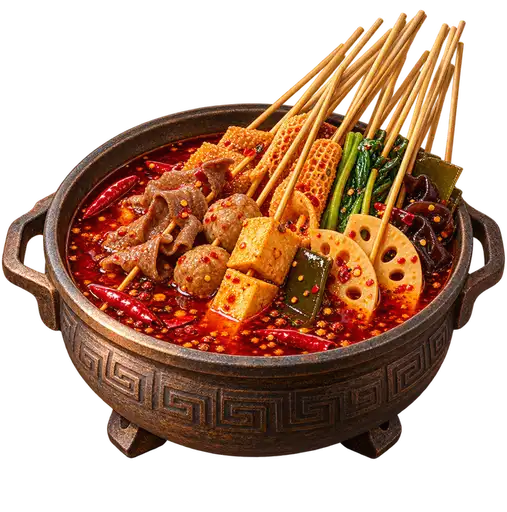
Then and now. The room is set around 1900. The dishes Chengdu people eat standing up today, 串串香, skewers boiled in a red pot and counted by the stick, are later. Accounts in Chinese sources date Chengdu's street stalls of skewers to the mid-1980s, though some tell it as a boatmen's dish from the river town of Leshan, and nothing in the sources settles the date. A traveller from 1900 would find the broth, the chilli and the pepper familiar. The sticks would be new.
On the balcony behind them, the diners are still at the table. The bell does not move.
Sources and further reading
- Chang Qu (常璩), 《华阳国志》(Huayang Guozhi), Shu Zhi (卷三 蜀志), 4th century Supports: the brocade officers' quarter 锦官 and the passage that brocade washed in this river was brighter, hence 锦里 / Brocade River.
- Du Fu (杜甫), 《春夜喜雨》, 761; context at Baidu Baike, “Du Fu Thatched Cottage” Supports: written in spring 761 while he lived in the Chengdu cottage; the line 花重锦官城.
- UNESCO World Heritage Centre, “Mount Qingcheng and the Dujiangyan Irrigation System” Supports: Li Bing and the 256 BC works, still operating, inscribed 2000.
- Baidu Baike, 《串串香》 Supports: street-stall skewers in Chengdu from the 1980s; the Leshan boatmen account (marked as legend).