Landmark · The south and the Andaman · ภาคใต้ · Thailand · around 1900
The sea people's boatsเรือชาวเล
A house, a boat and a livelihood, hollowed from one log.
The story
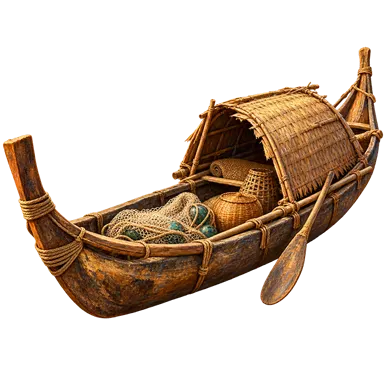
Two boats lie on a mooring off the sand, and they are houses as much as boats. Three related peoples have worked this coast: the Moken of the Mergui archipelago, the Moklen of Phang Nga and the Urak Lawoi from Phuket south to Satun, in the Andaman since at least the eighteenth century and traditionally aboard a hand-built kabang, hollowed from a single old-growth log and about four months in the making.
The boat is fitted for living: a shallow hull, a palm-thatch roof over the middle, a hearth, and room for a family and its gear. The monsoon decides the year: when the wind turns the boats move to the sheltered side of an island, and when it turns back they move again.
The engine-driven longtail boat is a later invention, credited to Sanong Thitibura of Sing Buri in the 1930s, who mounted an engine on a rowing boat and lengthened the propeller shaft. Before that the hulls on this coast carried a sail, or oars.
Today
Long-tail boats now run on car-style engines at the end of a long shaft, and most carry tourists between islands and beaches.