Landmark · Istanbul · İstanbul · Turkey · around 1900
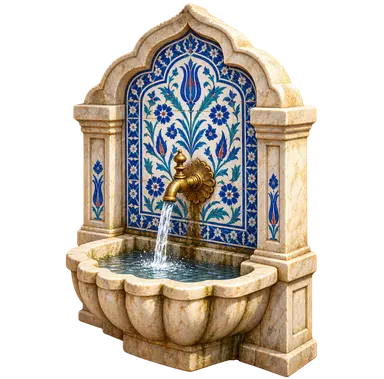
The İznik-tiled fountainÇinili çeşme
Blue tiles, flowing water and a place to pause.

The story
A çeşme is a public fountain. In Istanbul’s old streets, people without a private water supply took their water from stone fountains with spouts and basins.
The best-known one in Istanbul is the Fountain of Ahmed III beside Topkapı Palace, built in 1728 to 1729. A fountain like it gave the public water, and it was also a gift from the person who paid for it, with fine decoration.
The blue-and-white tile patterns follow Ottoman ceramic decoration, and water runs into four basins beneath a broad roof. The cool colours stand out against warm stone, wooden bays and terracotta roofs.
People stopped here to drink and to meet before the next errand, and the lanes beyond lead to the simit cart on the quay and the charcoal smoke of the next counter.
Today
Piped water reached Istanbul homes during the twentieth century, and most public fountains no longer run. The Fountain of Ahmed III still stands outside Topkapı Palace.